Measure Distance

Measure Area

Click on the map to add points. Double‑click to finish.

Tap on the map to add points.

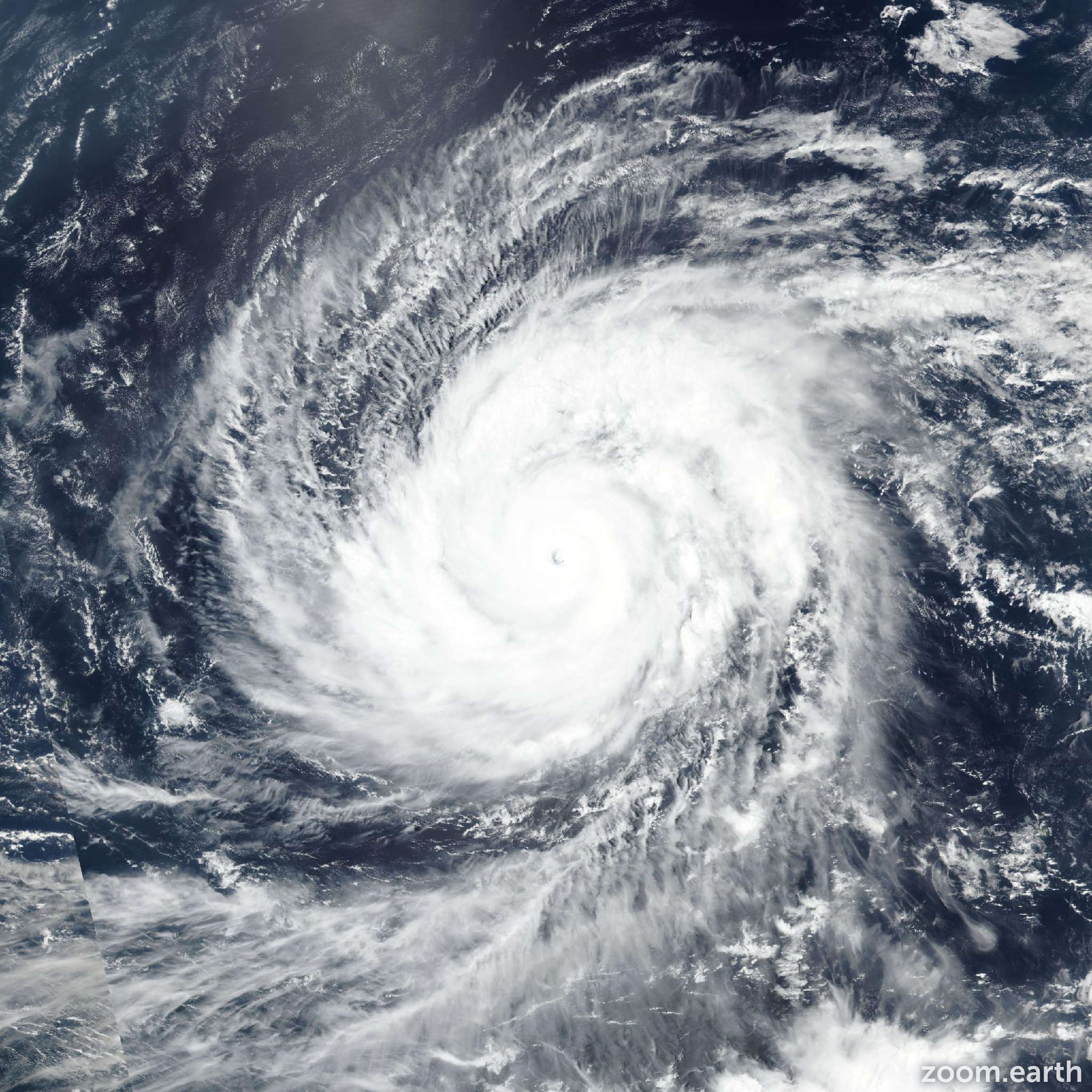
Typhoon Sinlaku 2026

Last Modified:

Typhoon Sinlaku

Live tracking map, satellite, radar, and forecasts of Typhoon Sinlaku 2026 in the western Pacific Ocean. Current wind speed 150km/h. Max 230km/h.

Sinlaku is located 889 km east-southeast of Guam, and has tracked northwestward at 7 km/h (4 knots) over the past 6 hours. Maximum significant wave height is 8.5 meters (28 feet).

While the steering mechanism is currently weak, resulting in very slow translational speeds, the near-equatorial ridge centered to the southeast is expected to develop a northward propagating extension, eventually assuming primary steering. As a result, Sinlaku is forecast to steadily pick up speed, while tracking generally northwestward towards the southern Mariana Islands.

With the environment remaining highly favorable for rapid intensification, Sinlaku is forecast to reach a peak of 230 km/h (125 knots) in around 2 days, ahead of the final approach toward the island chain.

Given the impressive wind field size, the 65 km/h (34 knots) wind radii will be in reach of the Marianas in 36 to 48 hours. In around 3 days, Sinlaku is expected to begin its recurvature motion around the southwestern edge of the building extension of the near-equatorial ridge.

The system is expected to start weakening at that point, given slowly increasing wind shear. Model guidance is in fair agreement in regard to the general steering pattern and the recurvature scenario, and while the cross-track spread among the consensus members has improved, it is still rather significant at 343 km for the next 3 days. As such, the official JTWC forecast is assessed with medium confidence and is laid close to the multi-model consensus.

Primary outliers remain UKMET deterministic and GALWEM predicting track northeast of Tinian, while the remaining models are contained within a 167 km cross-track envelope encompassing area southwest of Guam and the island of Rota.

Over the last several model runs, all available guidance appears to be converging within an area between Guam and Rota. In regard to intensity, JTWC forecast is laid close to that of HAFS, and just above the multi-model consensus, with medium confidence throughout the forecast period.

While global deterministic and statistical-dynamical models are more conservative, with peak intensities around 175–215 km/h (95–115 knots), several rapid intensification aids are indicating maximum winds reaching 135+ knots.

HAFS is predicting a peak of 230 km/h (125 knots) at 2 days, consistent with the official JTWC assessment.