Measure Distance

Measure Area

Click on the map to add points. Double‑click to finish.

Tap on the map to add points.

Tropical Cyclone Luana 2026

Last Modified:
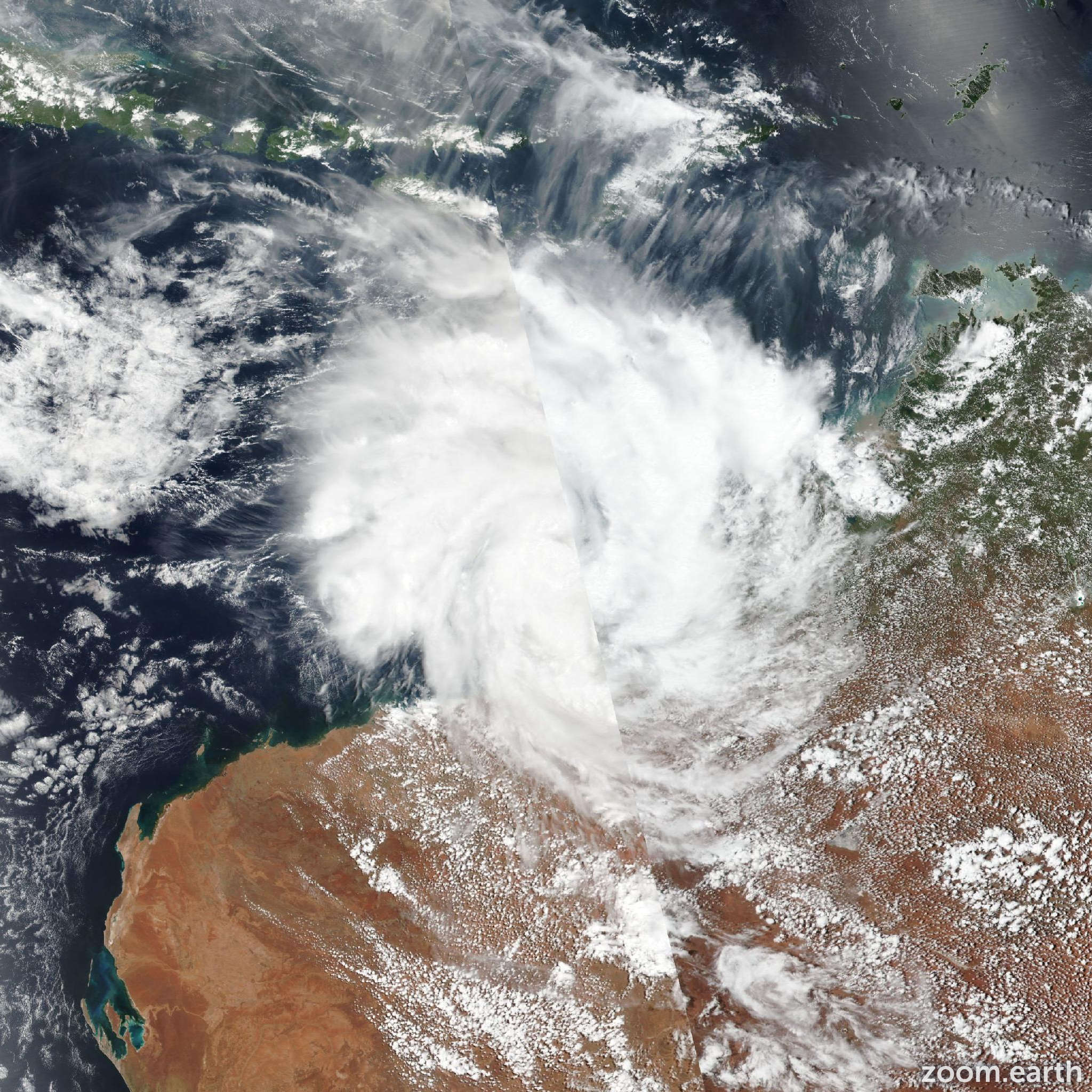
Cyclone Luana

Live tracking map, satellite, radar, and forecasts of Tropical Cyclone Luana 2026 near Broome, Australia. Current wind speed 85km/h.

Luana is located 228 km north-northwest of Broome, Australia, and has tracked southeastward at 22 km/h (12 knots) over the past 6 hours. Maximum significant wave height is 6.4 meters (21 feet).

Luana is forecast to track southeastward along the southwestern edge of a deep-layer near-equatorial ridge positioned far to the northeast over the next 12 to 24 hours. Landfall along the Dampier peninsula is expected to occur within the next 12 hours, after which the system will move inland to the east of Broome.

After 24 hours, steering influence transitions to a subtropical ridge building over central Australia, recurving the remnants of Luana southward towards the Great Sandy Desert.

During the limiting duration remaining over water, Luana will traverse very warm (30–31°C) waters offshore the Dampier peninsula, sustaining intensification until coastal interface.

The deterministic forecast calls for a peak intensity of 100 km/h (55 knots) coincident with landfall; however, statistical probability suggests a peak closer to 110–120 km/h (60–65 knots), should the track deflect further south than anticipateda trend indicated by recent radar imagery.

Following landfall, the system will decay rapidly due to frictional effects and reduced moisture flux, dissipating as a significant tropical cyclone in 36 hours.

Numerical weather prediction (NWP) track guidance is in strong agreement, validating a southeastward trajectory with landfall within 12 hours, followed by a poleward turn by the end of the forecast period.

The JTWC forecast track is aligned with the multi-model and AI consensus means, with high confidence. Indicate a southern deviation over the past two hours, which may represent either a trochoidal oscillation or a track shift.

If the more southward trajectory persists, the system will remain over water longer and the landfall position will shift closer to Broome, though at this point in time this is a remote possibility.

Intensity guidance is also in good agreement, with the majority of models indicating intensification over the next 12 hours, up to a peak of 100 km/h (55 knots), followed by rapid weakening through the end of the forecast period.

The potential for a higher peak intensity is derived from environmental analysis and is not explicitly captured in the model data. Additionally, if the system tracks more southward vice southeastward and remains over water longer, the peak intensity will be higher as a result.

The JTWC forecast is placed slightly above the consensus mean with medium confidence.