Measure Distance

Measure Area

Click on the map to add points. Double‑click to finish.

Tap on the map to add points.

Tropical Storm Higos 2026

Last Modified:

Tropical Storm Higos

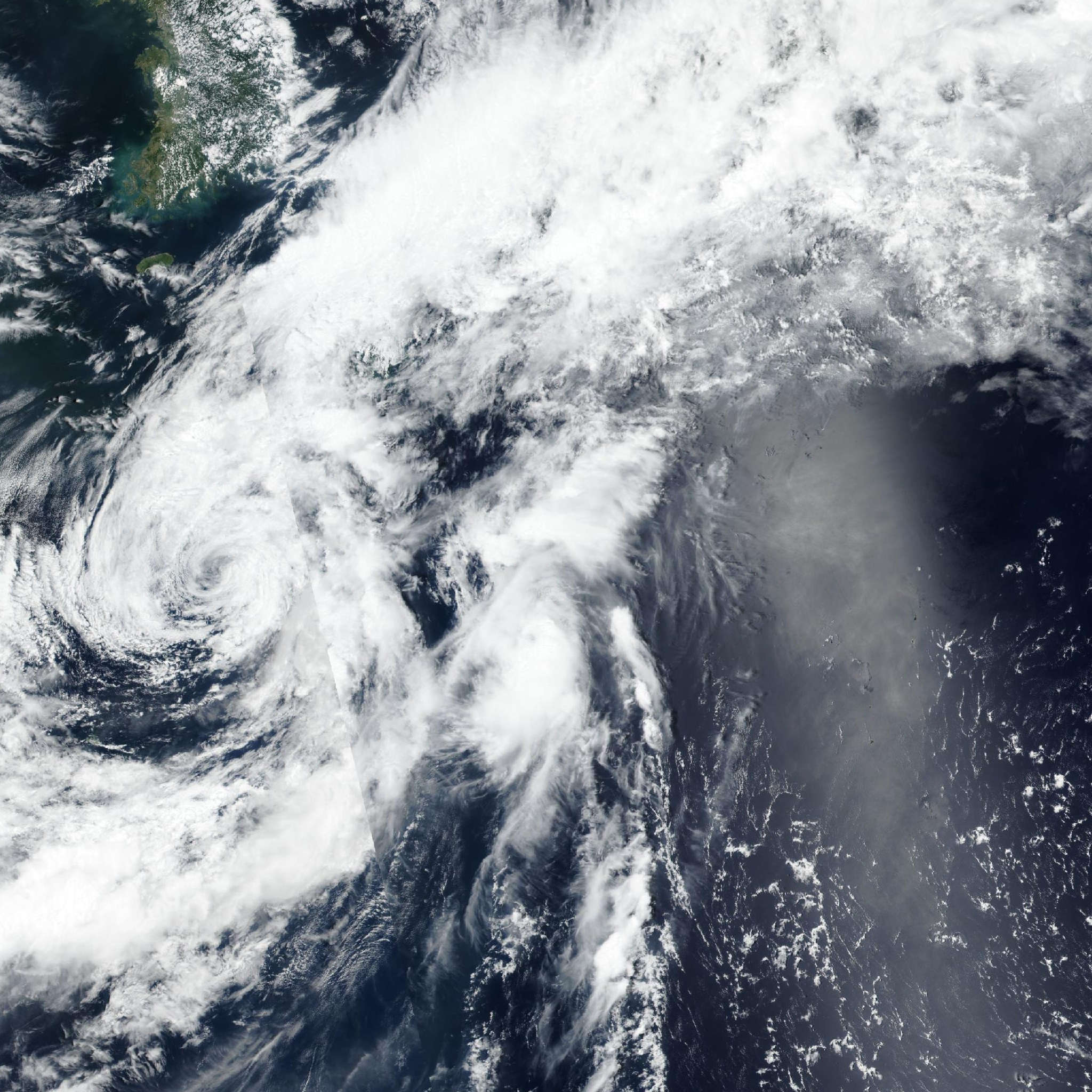
Live tracking map, satellite, radar, and forecasts of Tropical Storm Higos 2026 (台風8号) near the Northern Mariana Islands. Current wind speed 65km/h. Max 95km/h.

Higos is located 33 km south of Tinian, and has tracked west-northwestward at 17 km/h (9 knots) over the past 6 hours. Maximum significant wave height is 4.3 meters (14 feet).

Tropical storm Mekkhala is being steered to the west-northwest by a lower level subtropical ridge, which will continue over the next 36 hours.

The system will approach a weakness in the subtropical ridge and round the ridge axis after 60 hours. The mid-latitude westerlies will pull the system northeastward, and extratropical transition (ETT) will rapidly occur.

While the forecast shows a the next 5 days point to show completion of ETT, Higos will more than likely be absorbed by a frontal system near the Kuril Islands by that time.

The ASCAT-B indicated that 55–65 km/h winds (30–35 knots) have now wrapped around 50% of the low-level circulation center, a notable improvement in the symmetry of the wind field.

The forecast still calls for slow intensification due to remaining asymmetries in the structure and persistent southeasterly shear over the next 24 hours. However, in 1 to 2 days, conditions will become more favorable for development.

The wind shear will ease, while the sea surface temperatures will hover near 30°C. These factors will promote steadier intensification before the larger, more potent circulation of Mekkhala interacts with Higos and caps further development.

After 3 days, increasing wind shear and cooler sea surface temperatures will induce weakening. Several scenarios remain possible: Mekkhala could still absorb Higos leading to dissipation of the tropical storm in around 3 days, although this is becoming less likely.

There is also a possibility that Higos taps into a jet stream over northern Honshu, which would lessen the rate of weakening. The available guidance generally agrees on a recurvature scenario for Higos, and the JTWC forecast track is laid within the tightest cluster of models over the next 3 days with medium confidence.

Uncertainty regarding the extent of interaction with Mekkhala lends low confidence after 3 days. NAVGEM and a flurry of AI models reside on the eastern side of the guidance envelope, which are most susceptible to significant interaction with Mekkhala.

After 3 days, the track forecast follows the mean of the GFS and ECMWF global models, which tend to have higher skill dealing with baroclinic systems.

The reliable intensity aids show modest intensification for the next 2 to 3 days. The experimental Google DeepMind and COAMPS-TC are the most aggressive and show a peak of 100 km/h (55 knots).

HAFS-A is lower at 95 km/h (50 knots), while GFS sits at 85 km/h (45 knots).

The intensity forecast is set on the higher end of the guidance with medium confidence over the next 3 days and low confidence thereafter.