Tropical Cyclone Dudzai 2026
Last Modified:
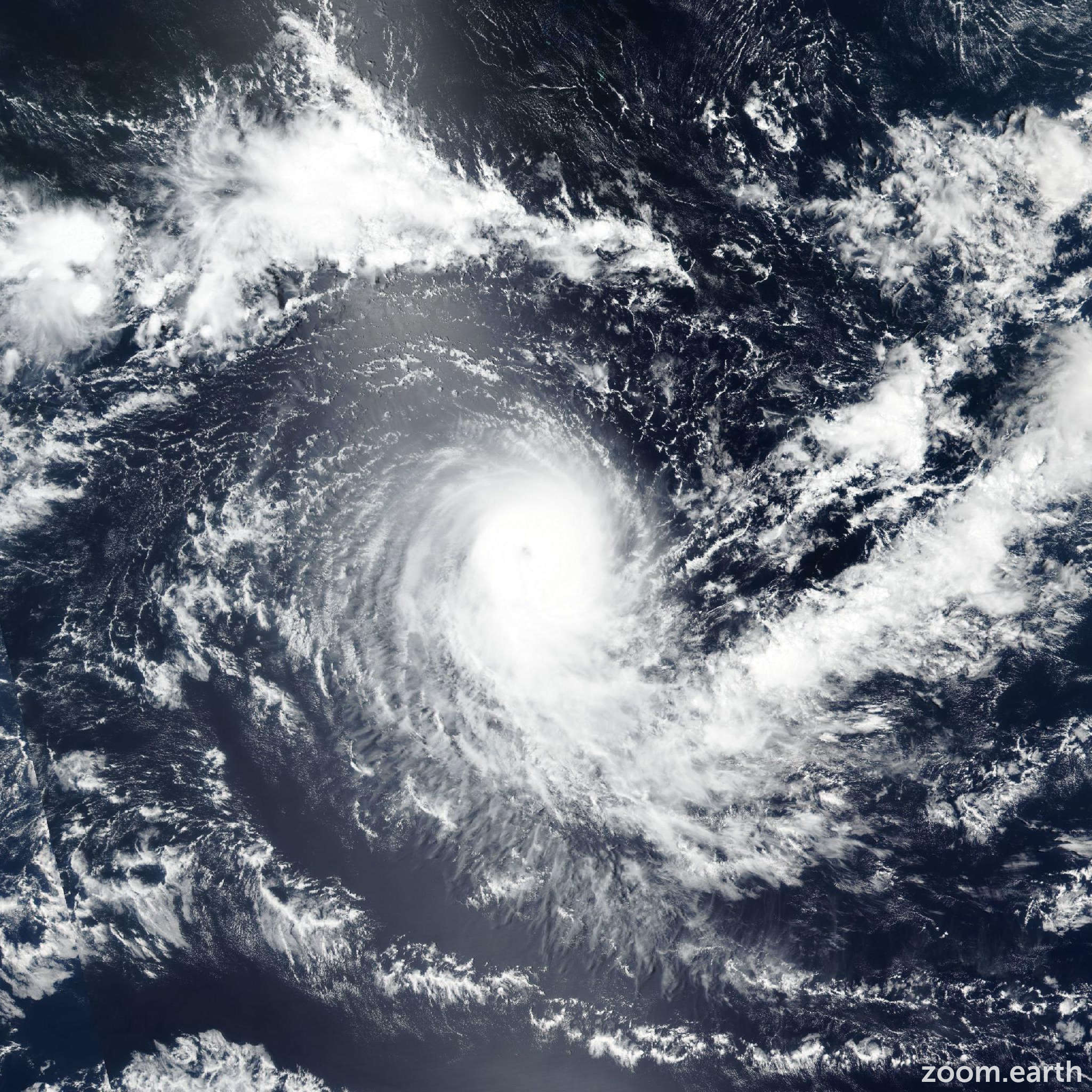
Live tracking map, satellite, radar, and forecasts of Tropical Cyclone Dudzai 2026 in the southwest Indian Ocean. Current wind speed 230km/h. Max 240km/h.
Dudzai is located 1602 km east of Port Louis, Mauritius, and has tracked westward at 11 km/h (6 knots) over the past 6 hours. Maximum significant wave height is 10.7 meters (35 feet).
Dudzai will continue tracking generally westward for the next 12 hours, at which point the subtropical ridge to the southwest will shift and induce a southwestward track through the remainder of the forecast period.
Dudzai is forecast to reach peak intensity at 12 hours, just before turning southwestward. As Dudzai tracks further southwestward, it will entrain copious amounts of dry air into the northern and eastern flanks.
Dry air entrainment is expected to be the leading cause of weakening, though contributing factors include wind shear and sea surface temperatures.
Dudzai is forecast to cross the 26°C isotherm in around 4 days, which will further weaken the storm. Additionally, a microwave image shows the possibility of Dudzai attempting an eyewall replacement cycle, signaled by the developed deep convection extension from the southern semicircle and the strip of low emissivity outside the eyewall that may develop into a moat.
The eye diameter slightly expanded in infrared imagery, supporting the possibility. Should Dudzai begin an eyewall replacement cycle, it would likely fail to complete the full cycle and ultimately increase the rate of weakening, as Dudzai has very limited time to complete the cycle and reintensify before beginning its terminal weakening trend after 24 hours.
Deterministic track model guidance is in overall strong agreement, with only minor spread in both the cross-track and along-track direction. The JTWC track forecast is placed with high confidence over the next 3 days and medium confidence in 3 to 5 days.
Reliable intensity guidance is in good agreement that Dudzai peaked and should be expected to steadily weaken through the end of the forecast.
The JTWC intensity forecast deviates from model guidance, as previous intensity analyses and increasing Dvorak estimates suggest that Dudzai will continue to intensify.
The favorable environment also supports further intensification in the near-term. The JTWC intensity forecast converges with model guidance at 3 days, increasing confidence in the weakening trend for the later forecast hours. As a result, the JTWC intensity forecast is assessed well above guidance with low confidence over the next 3 days and medium confidence in 3 to 5 days.